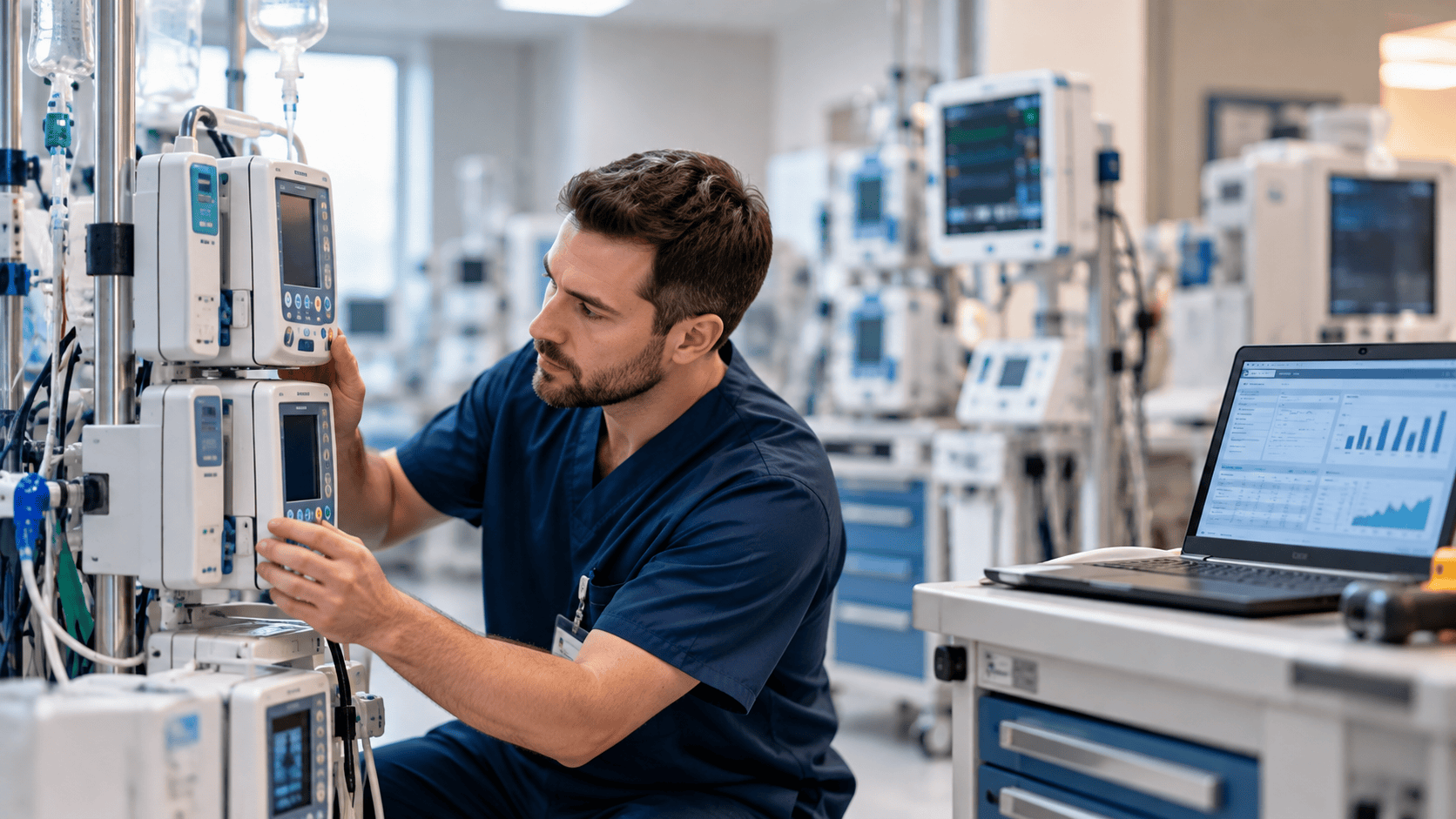
Two pieces of medical equipment were purchased in the same year. Both have reached the end of their expected useful life. One continues to perform reliably with manageable maintenance costs. The other experiences frequent breakdowns, increasing service expenses, and disruptions to clinical workflows. Should both be replaced simply because they’ve reached the same age?
For healthcare organizations managing aging equipment fleets and competing capital demands, the answer isn’t always straightforward. Equipment age provides an important reference point, but it doesn’t necessarily indicate whether an asset is still delivering value or when replacement becomes the better investment.
Replacing equipment too early can tie up capital that could be directed toward more pressing needs. Waiting too long can lead to rising maintenance expenses, operational disruptions, and potential risks to patient care.
The challenge is determining when continued investment in an existing asset makes sense, when an upgrade may be sufficient, and when replacement becomes the most appropriate course of action.
Making that determination requires looking beyond the calendar and evaluating how equipment is performing, how it’s being used, what it costs to maintain, and whether it continues to meet clinical and operational needs.
1. Equipment Age Is a Starting Point, Not a Replacement Decision
Expected useful life plays an important role in capital planning. It helps organizations anticipate replacement needs, develop longer-term budgets, and identify equipment that may warrant closer evaluation.
But reaching a particular age doesn’t automatically mean an asset should be replaced.
Consider two imaging systems of similar age. One has been consistently maintained, experiences minimal downtime, and continues to meet clinical requirements. The other has recurring failures, increasing repair costs, and limited availability of replacement parts.
Although both may appear equally due for replacement based on age, their condition and operational impact tell different stories.
A more complete evaluation considers several factors:
- Reliability and performance: Is the equipment consistently meeting expectations, or are failures becoming more frequent?
- Maintenance history: Are repairs increasing in frequency, complexity, or cost?
- Clinical risk: Does the equipment continue to support safe, effective patient care?
- Serviceability: Are replacement parts, software updates, and technical support still available?
- Clinical relevance: Can the equipment support current practices and requirements?
- Operational impact: Are breakdowns or performance limitations disrupting care delivery?
These indicators help distinguish equipment that is simply aging from equipment that presents a more immediate need for intervention.
For example, a device that has exceeded its expected useful life may remain suitable for continued use if it performs reliably and manufacturer support remains available. Conversely, newer equipment experiencing repeated failures or significant clinical limitations may warrant earlier replacement.
The distinction matters because replacement priorities should reflect actual conditions rather than assumptions based solely on purchase dates.
The oldest equipment isn’t necessarily the equipment that should be replaced first.
2. Before Replacing Equipment, Understand How It's Being Used
A request for new equipment often begins with an operational challenge. A department may be experiencing scheduling delays, increasing patient volumes, or limited access to a particular system.
Purchasing additional equipment or replacing an existing asset may appear to be the most direct solution.
But before committing capital, organizations should determine whether the problem stems from insufficient capacity, inefficient utilization, or limitations that could be addressed another way.
Consider a department struggling to access equipment during peak hours. Utilization data may reveal that demand is concentrated during certain periods while the equipment remains underutilized at other times.
In that situation, adjusting scheduling practices or coordinating equipment use across departments might improve availability without an immediate purchase.
Similarly, an organization may discover that existing equipment could continue meeting clinical needs through a manufacturer-supported software upgrade, component replacement, or workflow adjustment.
Understanding utilization helps leaders explore questions such as:
- Is the equipment operating near its practical capacity?
- Are scheduling patterns creating avoidable bottlenecks?
- Is similar equipment available elsewhere in the organization?
- Could resource sharing or workflow changes improve access?
- Would an upgrade address the underlying clinical need?
Utilization data alone won’t determine the answer. Equipment location, patient safety, clinical requirements, and operational constraints must also be considered.
An asset may appear underutilized but still be essential for emergency access or specialized procedures. Likewise, high utilization doesn’t automatically justify replacement if the equipment continues to perform reliably.
The value of utilization analysis is that it helps organizations distinguish between a true equipment need and an opportunity to use existing resources more effectively.
The objective isn’t to avoid equipment purchases. It’s to ensure that a purchase addresses the problem the organization is trying to solve.
3. What Is the True Cost of Keeping Equipment in Service?
The purchase price of a new system is often the most visible financial consideration in a replacement decision. The cost of keeping existing equipment in service can be less obvious.
An older asset may appear economical because it has already been purchased and continues to operate. But recurring repairs, service contracts, replacement parts, downtime, and operating expenses can gradually change that calculation.
Conversely, replacing a reliable asset may require substantial capital without delivering a proportionate clinical or operational benefit.
This is where a total cost of ownership perspective becomes valuable.
Rather than comparing the purchase price of new equipment with the cost of a single repair, organizations should examine the broader financial implications of each option.
Key considerations include maintenance expenses and their trends, service contract costs, parts availability, equipment downtime, operating requirements, and the anticipated cost of continued ownership.
The replacement alternative also requires a complete financial assessment. Acquisition costs may represent only part of the investment. Installation, training, infrastructure modifications, technology integration, and ongoing service expenses can significantly affect the total commitment.
Consider an imaging system requiring increasingly frequent repairs. A single repair may cost substantially less than replacement. But if the system continues to fail, disrupts patient scheduling, and requires expensive parts, retaining it may become less economical over time.
By contrast, a system with predictable maintenance expenses, strong reliability, and continued clinical relevance may remain a sound investment even after exceeding its expected useful life.
The analysis should also consider the operational consequences of downtime. Equipment failures can affect patient throughput, staffing efficiency, scheduling, and the ability to deliver services. These impacts may be difficult to quantify precisely, but they should not be ignored.
A lower upfront expense doesn’t always mean a lower long-term cost.
Understanding these trade-offs helps leaders determine whether maintenance, an upgrade, or replacement offers the most appropriate balance of cost, performance, and clinical value.
4. The Risk of Replacing Equipment Too Soon—or Too Late
Even when equipment will eventually need replacement, determining the right timing introduces another layer of complexity.
Replacing equipment prematurely can consume capital while an existing asset remains reliable and clinically appropriate. Deferring replacement too long can increase financial exposure, operational disruption, and patient safety risks.
The challenge is identifying when the benefits of replacement begin to outweigh the costs and risks of continued ownership.
When replacement happens too early
Premature replacement can create unnecessary financial pressure, particularly when multiple capital needs compete for limited resources.
If equipment continues to meet clinical requirements with manageable maintenance expenses, replacing it solely because it has reached a predetermined age may not represent the best use of capital.
A new system may also introduce implementation expenses, training requirements, and workflow changes.
These costs may be justified when replacement delivers meaningful improvements in clinical capability, reliability, efficiency, or patient care. But those benefits should be evaluated against the value the existing asset can continue to provide.
When replacement happens too late
Delaying replacement creates a different set of risks.
Service needs may become more frequent, parts harder to obtain, and manufacturer support limited or unavailable. Unexpected failures can disrupt clinical operations and force organizations into urgent purchasing decisions.
Under those circumstances, leaders may have less time to evaluate alternatives, negotiate pricing, or coordinate implementation.
Older technology may also become less suitable as clinical practices, cybersecurity requirements, and organizational standards evolve.
An asset doesn’t have to fail completely before replacement becomes justified. Declining reliability, reduced serviceability, or increasing clinical limitations may signal that continued ownership is no longer the appropriate choice.
Finding the right replacement window
The ideal replacement window isn’t necessarily a specific age or calendar year. It’s the point at which equipment condition, clinical requirements, operating costs, and future needs support a change.
That assessment should evolve as circumstances change.
Equipment initially scheduled for replacement several years from now may need attention sooner if reliability declines or manufacturer support ends. Another asset may remain suitable for continued use longer than anticipated because of strong performance and manageable costs.
Regular reassessment helps organizations make replacement timing more responsive to actual conditions rather than relying exclusively on fixed schedules.
It also creates opportunities to plan purchases, evaluate alternatives, and coordinate implementation before an unexpected failure forces an urgent decision.
5. Repair, Upgrade, Replace, or Defer: Choosing the Right Path
Once an organization understands an asset’s condition, utilization, costs, and clinical requirements, the next step is selecting the most appropriate action.
Replacement isn’t the only option. Depending on the circumstances, repair, upgrade, or continued use with monitoring may better address the organization’s needs.
Repair: When the existing asset still delivers value
Repair may be appropriate when equipment continues to meet clinical and operational requirements and a specific issue can be corrected at a reasonable cost.
The evaluation should consider whether the repair will restore dependable performance, whether parts and technical support remain available, and how much useful service life the organization can reasonably expect afterward.
Repeated repairs that fail to resolve underlying reliability problems may indicate that continued investment is no longer justified.
Key question: Will the repair restore reliable performance at a reasonable cost?
Upgrade: When capabilities need to improve
Sometimes the underlying equipment remains functional, but evolving clinical or operational requirements call for enhanced capabilities.
A manufacturer-supported software update, component replacement, or technology upgrade may address those needs without requiring a complete replacement.
Before proceeding, organizations should assess compatibility, manufacturer support, implementation costs, expected benefits, and the remaining useful life of the equipment.
Key question: Can an upgrade address the need effectively without replacing the entire system?
Replace: When continued ownership no longer makes sense
Replacement may be warranted when equipment can no longer reliably meet clinical requirements or when continued operation presents increasing costs, risks, or performance limitations.
Indicators may include recurring failures, escalating maintenance expenses, unavailable parts, discontinued support, inadequate capacity, or significant clinical limitations.
New technology may also justify replacement when it offers meaningful benefits that cannot be achieved through repair or upgrade.
Key question: Do the clinical, operational, and financial benefits justify the replacement investment?
Defer: When continued use remains appropriate
Deferring replacement can be a responsible decision when equipment remains safe, reliable, clinically appropriate, and economical to maintain.
But deferral shouldn’t mean postponing the decision indefinitely.
A well-supported deferral includes a documented rationale, ongoing monitoring, and clear conditions for reassessment.
For example, an organization might continue operating an asset while tracking downtime, repair frequency, maintenance expenses, and manufacturer support. If those indicators change materially, the replacement decision can be revisited.
Key question: What evidence supports continued use, and what would trigger reconsideration?
These options aren’t always mutually exclusive. An organization may repair equipment to maintain operations while preparing for replacement or implement an upgrade that extends its useful life.
What matters is that the selected approach is supported by evidence and appropriate to the asset’s clinical, operational, and financial circumstances.
Making Replacement Decisions with Greater Confidence
Determining when to replace capital equipment requires more than knowing how long an asset has been in service.
Equipment performance, maintenance history, utilization, clinical requirements, lifecycle costs, and replacement timing all influence whether an organization should continue using an asset or invest in an alternative.
Evaluating these factors together helps healthcare leaders make more deliberate decisions about when to repair, upgrade, replace, or defer.
The goal isn’t to replace equipment as quickly as possible—or keep it operating as long as possible. It’s to make the right investment at the right time.
Staritas helps healthcare organizations bring greater visibility to these decisions through independent capital equipment pricing benchmarks, market intelligence, and specialized expertise. Solutions including Capital Guide, Predictive Replacement Planning, and Biomedical Guide support equipment evaluations, replacement planning, and more informed capital investment decisions.
Hear How Healthcare Leaders Are Approaching Capital Planning Under Pressure
How are healthcare organizations evaluating equipment needs, balancing replacement priorities, and deciding where to invest limited capital resources?
Watch our on-demand webinar, Capital Planning Under Pressure: How Healthcare Leaders Are Prioritizing What Matters Most, to hear firsthand perspectives from healthcare supply chain leaders on navigating difficult capital decisions and building more strategic approaches to planning.