Executive Summary
Healthcare manufacturers continue to invest heavily in innovation and commercialization, yet many still experience stalled growth, unexpected share loss, and increasing pricing pressure. The issue is often misdiagnosed. It is not a lack of product quality—it is a lack of visibility into how products perform relative to competitors in the market.
Today’s healthcare environment is highly comparative. Products are evaluated not in isolation, but against alternatives, pricing benchmarks, and real-world utilization patterns. As a result, being “better” is no longer sufficient. What matters is how a product performs in context—and whether that performance is clearly understood and actively managed.
High-performing organizations operate differently. They move beyond static reporting to gain real-time visibility into share movement, competitive dynamics, and utilization variability. They focus not just on what is happening, but why—and use that insight to proactively adjust pricing, positioning, and strategy. This shift from product-centric thinking to market-driven execution is what ultimately determines sustained growth.
The Myth of the “Better Product Wins”
There is a persistent expectation in healthcare that better products should translate into market share. Historically, this belief held true in more fragmented, clinician-driven environments. Today, however, it no longer reflects market reality.
The healthcare landscape has shifted significantly. Health systems are increasingly consolidated, purchasing decisions are more standardized, pricing transparency has increased, and there is greater scrutiny on how products are utilized across the organization. These changes have fundamentally altered how products are evaluated and adopted.
In this environment, products are not assessed in isolation. They are evaluated relative to contracted alternatives, market pricing benchmarks, and real-world utilization patterns. Decision-makers are not simply asking whether a product is better—they are determining whether it is the best option within the context of cost, consistency, and system-wide impact.
As a result, a product can be objectively superior and still lose share if it is not competitively positioned within this broader framework.
What’s Actually Driving Market Performance
Market performance is not determined by a single factor. It is shaped by a combination of forces that are constantly evolving.
Pricing variability across accounts influences both competitiveness and margin. Contract positioning determines access, but not necessarily utilization. Clinician behavior and substitution patterns drive real-world adoption. Health systems are increasingly prioritizing standardization, which can either accelerate or limit growth.
These dynamics interact in ways that are not always visible.
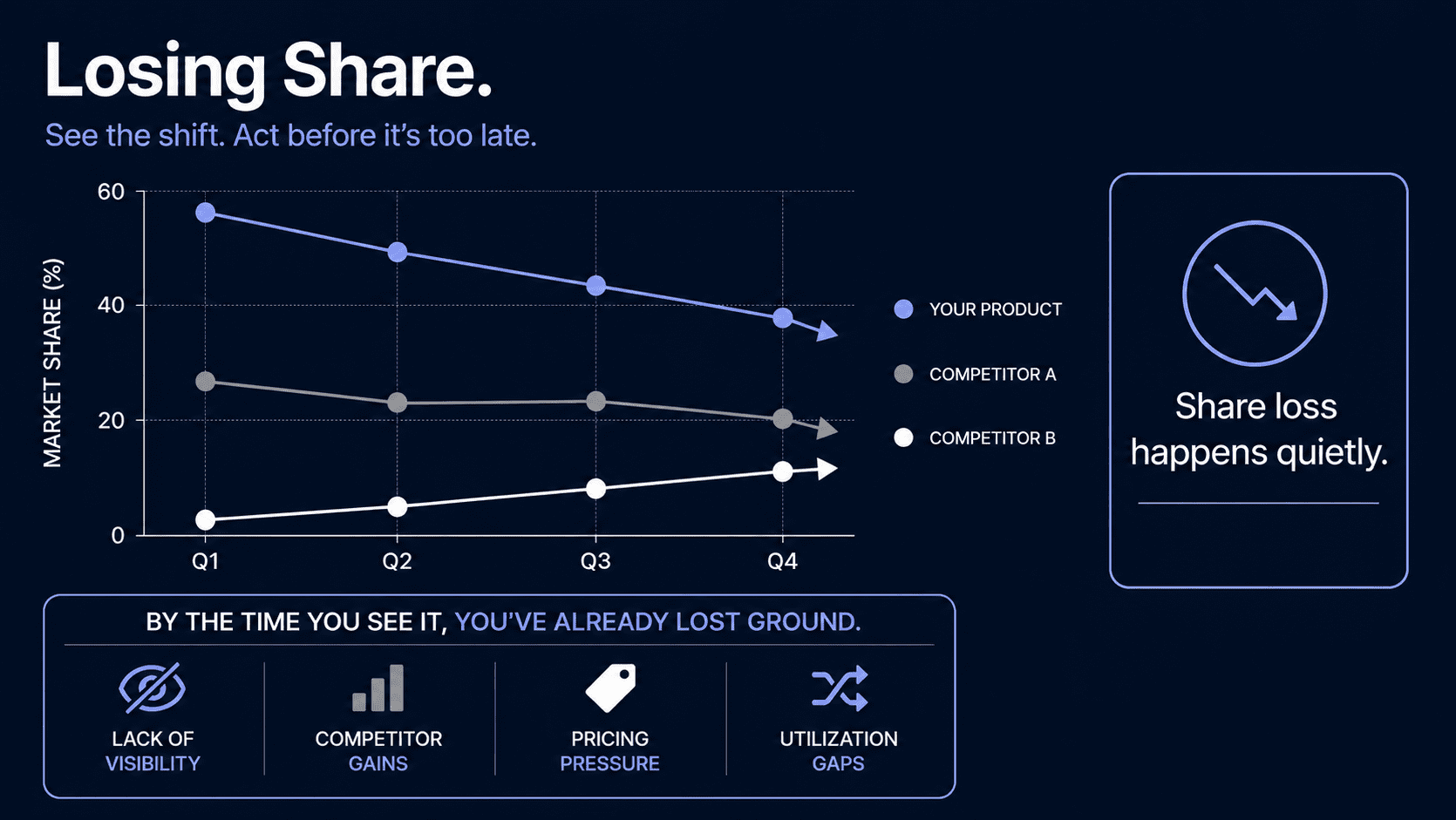
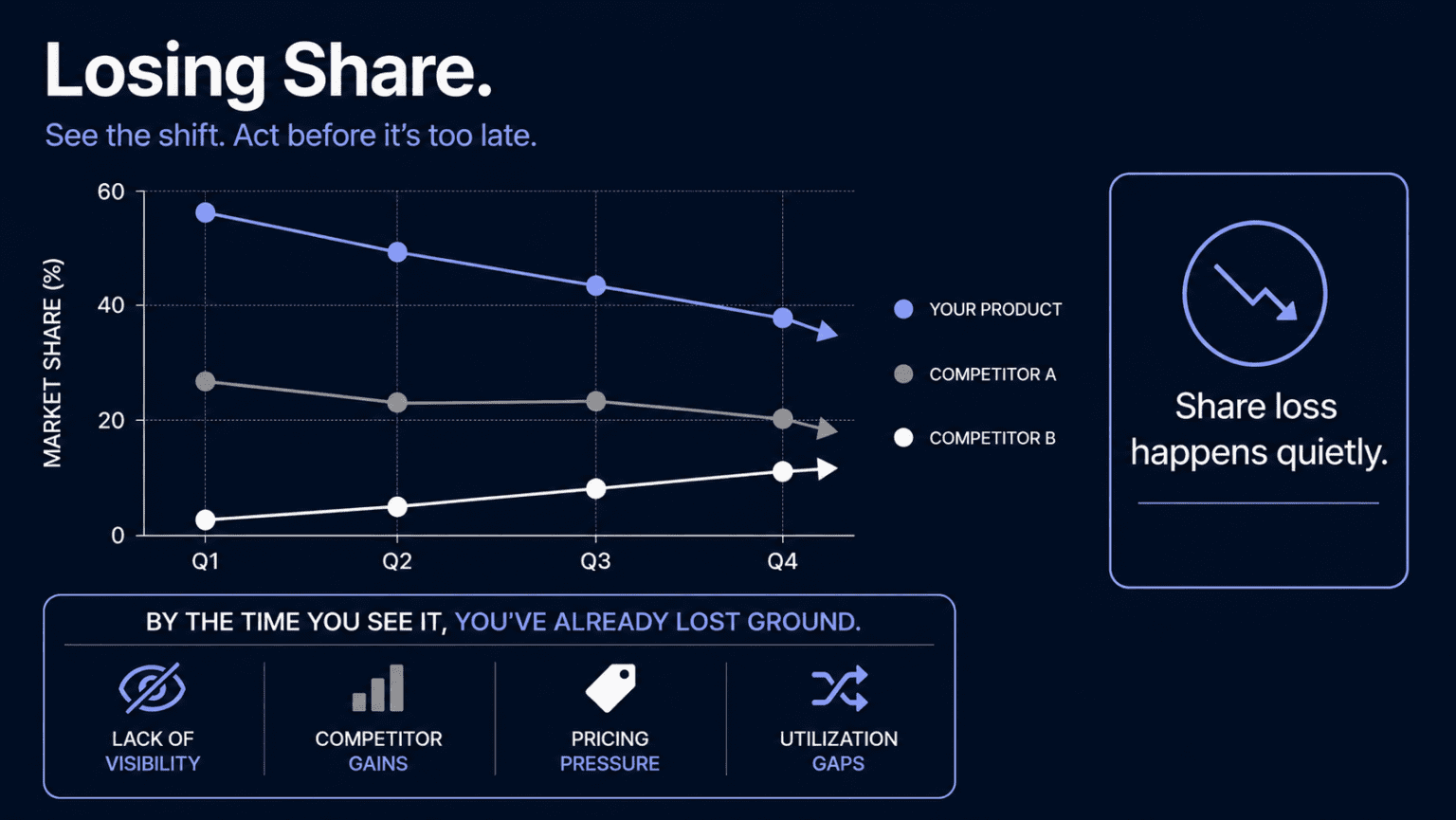
Manufacturers that rely on static reports or lagging indicators often find themselves reacting to changes rather than anticipating them. By the time performance declines are visible, the underlying shift has already occurred.
Where Manufacturers Lose Share (and Don’t Realize It)
One of the most consistent challenges is a lack of visibility into share movement. Many organizations track performance at a high level but lack the granularity needed to identify and validate early shifts across accounts, segments, or sites of care.
Competitive dynamics are also often misunderstood. Win/loss analysis often explains individual deals well, but coverage is incomplete and insights rarely translate into a consistent view of how performance is shifting across comparable situations. Without a clear, validated understanding of why competitors are gaining traction, it is difficult to adjust strategy effectively.
Pricing is another critical factor. Without benchmarking against the market, manufacturers risk either over-discounting—eroding margin—or mispricing and losing deals unnecessarily.
Finally, utilization patterns are frequently overlooked. Even within contracted accounts, usage can vary significantly. This variability creates hidden leakage, where expected share is not fully realized.
What High-Performing Teams Do Differently
Organizations that consistently outperform take a fundamentally different approach. They operate with market intelligence, that can be compared and validated across similar products and competitive situations—not just data that reflects internal performance or aggregated market views.
They track share at a granular level, allowing them to compare performance across similar products and competitive alternatives—so shifts can be identified, validated, and explained as they develop. They move beyond reporting to diagnosing the drivers behind change—understanding not just what is happening, but why.
Pricing is aligned with market reality. Instead of reacting to pressure, they proactively position pricing based on competitive benchmarks across comparable products and alternatives.
They also monitor utilization patterns closely, identifying gaps and opportunities within existing accounts. This enables them to drive growth not just through new deals, but through improved performance within current relationships.
Most importantly, they act on demand signals early. They recognize emerging trends in procedures, sites of care, and clinician behavior—and adjust strategy accordingly.
Final Perspective
The question is no longer whether a product is better.
The question is whether it is winning in the market—and whether the organization understands why.
Manufacturers that cannot answer that question with clarity are operating at a disadvantage, regardless of product strength.
If you lack clear visibility into your market position, you are likely missing opportunities—and exposing yourself to competitive risk.
Explore how Staritas can help you identify where you’re gaining or losing share—and why.